
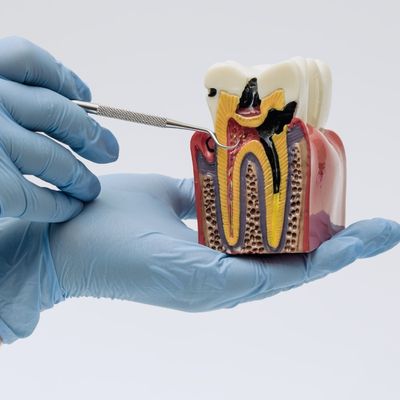
When most people picture a cavity, they imagine sharp tooth pain or a visible dark hole. Especially in the early stages, tooth decay rarely announces itself that way. Many cavities develop silently, with no pain and no obvious symptoms. And because they don’t hurt, it’s easy to assume a small cavity isn’t worth worrying about.
That assumption can be costly. Tooth decay doesn’t pause or heal on its own. What starts as a minor cavity can quietly grow into a much bigger and more expensive problem. The more you understand how dental caries progress, the easier it is to make decisions that protect your smile long term.
What Does a Cavity Look Like in the Early Stages?
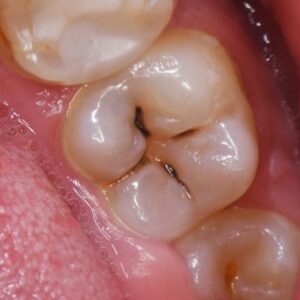
In the beginning, tooth decay may not look like much at all. You might notice a faint white or chalky spot on the enamel. That is a sign that minerals are being lost. A small dark spot or rough area on the tooth surface can also indicate early decay.
But here’s the part that surprises many patients: a cavity in its earliest stage often has no visible signs and no symptoms whatsoever. No pain. No sensitivity. Nothing you can feel with your tongue.
This is exactly why routine dental exams matter. Your dentist can identify early decay, sometimes before a hole has even fully formed. That means you can treat it before it progresses into something more serious.

What Are the Symptoms of a Cavity?
As decay advances, cavity symptoms begin to appear. The most common ones include:
- Sensitivity to hot, cold, or sweet foods and beverages
- A mild, lingering toothache
- Dark spots or visible discoloration on a tooth
- A rough or sticky area you can feel with your tongue
- Food repeatedly getting caught in the same spot
- Persistent bad breath that doesn’t resolve with brushing
If you’re experiencing any of these signs, the question to ask isn’t if you should be seen — it’s how soon. The earlier you address it, the simpler the treatment.

Why Cavities Don’t Heal on Their Own
One of the most important things to understand about tooth decay is that once a cavity forms, it cannot reverse itself. Unlike a cut on your skin, a tooth cannot repair a hole that has already developed.
The bacteria that caused the decay remain active in your mouth, continuing to feed on sugars and produce acid. Without treatment, they keep working. The cavity will deepen and widen while advancing toward the inner layers of the tooth.
Early-stage decay, before a hole has formed, can sometimes be slowed or remineralized with fluoride. But once that window closes, treatment is the only path forward.
How to Know If You Have a Cavity When You Don’t Have Pain
Many people wonder how to know if you have a cavity when nothing hurts. The honest answer is: you often can’t, on your own. That’s the nature of tooth decay in its early stages.
What you can do:
- Pay attention to any new sensitivity, even if mild
- Notice any visible changes in a tooth’s color or texture
- Keep up with regular dental exams — your dentist uses X-rays and clinical tools that detect decay long before it becomes painful
Pain is frequently a sign that decay has already reached deeper tooth layers. By the time a cavity hurts, it has typically been developing for a while.
What Happens If You Ignore a Cavity?
Tooth decay is progressive. A small cavity that seems manageable today will not stay small. Here is how decay typically advances when left untreated:
Larger fillings. As the cavity grows, more damaged structure must be removed. What could have been a small, straightforward filling becomes a larger restoration — less conservative, more involved.
Dental crown. If decay spreads far enough, a filling may no longer be sufficient to support the tooth. A crown becomes necessary to restore its strength and function.
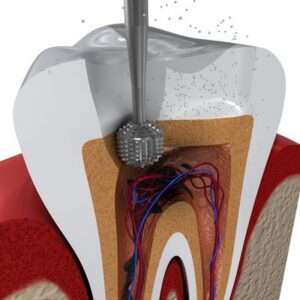
Root canal treatment. Once decay reaches the inner pulp of the tooth — where the nerves and blood vessels live — infection and inflammation follow. Root canal therapy is often the only way to save the tooth at this point.
Tooth loss. In the most advanced cases, decay damages a tooth beyond what can be repaired. Extraction becomes necessary, followed by a replacement option like a dental implant or bridge.
Every step along that progression is more time-consuming, more involved, and more expensive than the one before it. A small cavity treated early is almost always the better outcome — for your health and your budget.

How to Prevent Cavities and Tooth Decay
Prevention is always the goal. The good news is that tooth decay is largely preventable with consistent habits:
- Brush twice daily with a fluoride toothpaste
- Floss every day to remove plaque between teeth
- Limit sugary and starchy snacks and beverages
- Drink plenty of water, especially fluoridated water
- Attend regular dental exams and professional cleanings
- Ask your dentist about sealants or fluoride treatments if you’re at higher risk
At Cleveland Smile Center, we partner with our dental family to stay ahead of decay — catching problems early and building prevention plans that work for your lifestyle and your smile.
Don’t Wait for It to Hurt
A small cavity is a manageable problem. An untreated cavity is a much bigger one. The longer decay is left alone, the more tooth structure is lost and the more complex your treatment becomes.
If it’s been a while since your last exam, or you’ve noticed any of the warning signs above, the team at Cleveland Smile Center is here to help. We have four convenient locations across Northeast Ohio making it easy to get the care you need without delay.
Contact one of our offices today! Early treatment protects your tooth, your comfort, and your long-term oral health.
Additional Posts
-

Are you experiencing “Ozempic Teeth” or “Ozempic Breath”?
October 20, 2026
The Effect of GLP-1 Medication on Your Teeth You might have seen the statistics about the growing number of people in …
-

What Does Sugar Do to Your Teeth?
October 19, 2026
Do you or a loved one have a sweet tooth that's hard to control? If you answered yes, you aren't …
-

How To Brush Your Teeth: A Refresher
October 1, 2026
What Is the Right Way to Brush to Your Teeth? You have been brushing your teeth for your almost your entire …